
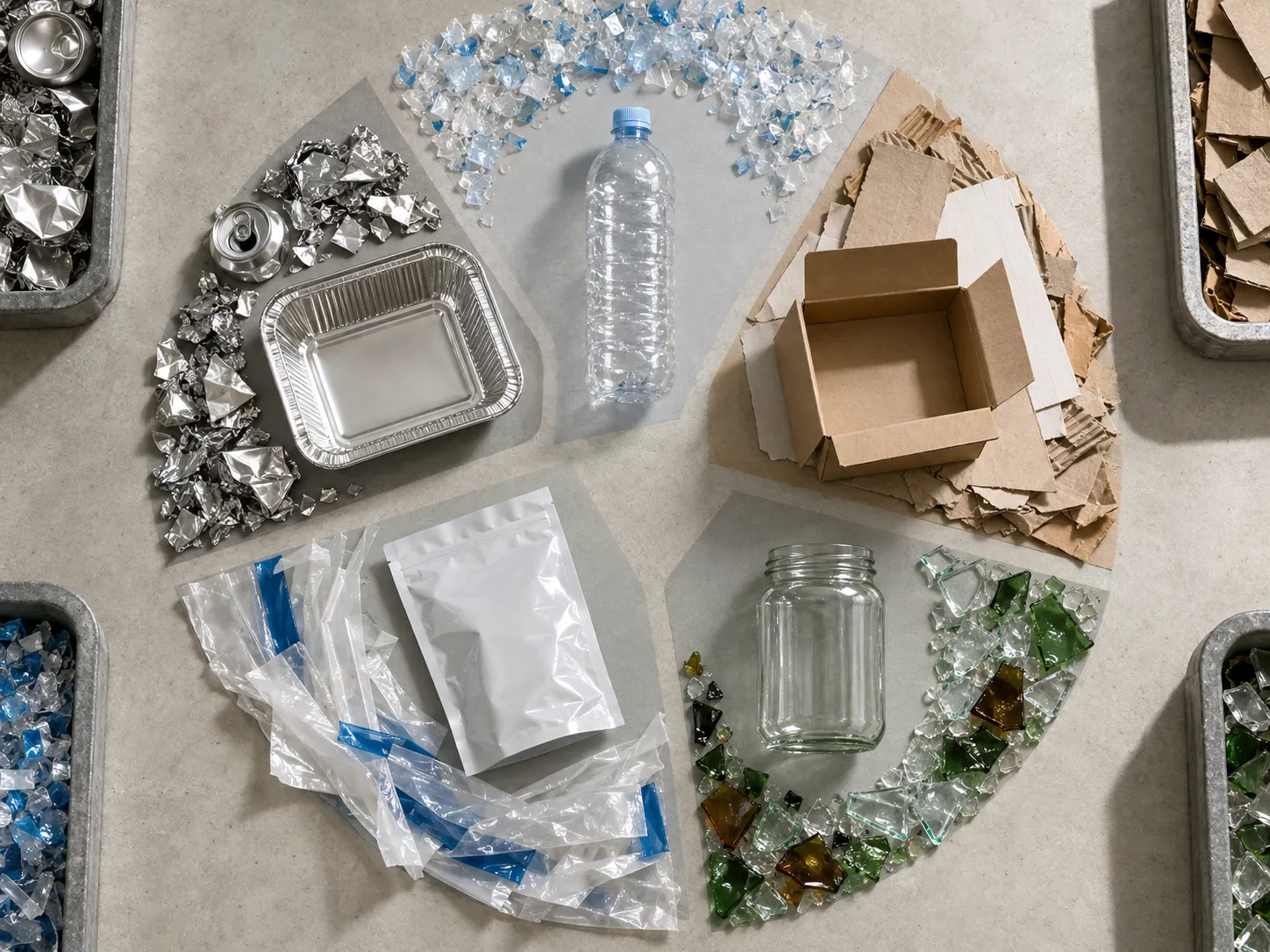
Recyclability of packaging under the Packaging and Packaging Waste Regulation
Packaging recyclability under the PPWR is not simply a matter of stating that cardboard, glass or plastic ‘is recyclable’. Regulation (EU) 2025/40 on packaging and packaging waste establishes a harmonised system in which recyclability is to be assessed according to design for recycling criteria and subsequently also according to whether a given packaging category is actually recycled at scale. The assessment result is to be expressed in recycling performance grades A, B or C.
For businesses, this means the need to collect much more detailed data on packaging design. Not only the main material may be relevant, but also labels, closures, adhesives, coatings, colourants, barrier layers and how individual components behave during sorting and recycling.
What does ‘recyclable packaging’ mean under the PPWR?
Article 6 of the PPWR links recyclability to the entire actual process of handling packaging waste. It is therefore not sufficient to demonstrate that a material can theoretically be processed under laboratory conditions.
Under the Regulation, recyclable packaging should be designed for material recycling and, once it becomes waste, it should be possible to collect it separately, sort it into the appropriate waste stream and recycle it without significantly impairing the recyclability of other waste streams.
At a later stage, the system will also take account of whether packaging belonging to a specific category is actually recycled at scale.
Design for recycling – the first pillar of Article 6 of the PPWR
Design for Recycling is intended to assess the design of a specific item of packaging. The Commission is to establish harmonised criteria for the packaging categories set out in Annex II.
The criteria are to take into account, among other things, the possibility of separately collecting, sorting and processing packaging in a way that allows material of adequate quality to be recovered.
In practice, this means moving away from a very general approach:
‘PET is recyclable’
towards the question:
‘Does this specific variant of a PET bottle, together with its label, adhesive, closure, colour and additives, meet the design for recycling criteria for its category?’
Recycling at scale is the second stage of assessment
The technical possibility of recycling does not yet mean that the packaging is actually recycled in practice. This is precisely why the PPWR introduces an additional element: recycling at scale.
The assessment is to take account of existing separate collection, sorting and recycling systems, as well as the actual quantities of material recycled for the relevant packaging categories.
The Regulation provides for the development of a uniform methodology and a mechanism for verifying origin. For this reason, you should not currently create your own definition of ‘recycling at scale’ and treat it as the final criterion for PPWR compliance.
PPWR recyclability grades: A, B and C
Annex II to the PPWR sets out recycling performance grades to be used to express the assessment result.
| Grade | Recycling performance | Meaning |
|---|---|---|
| A | at least 95% | Highest recycling performance grade |
| B | at least 80% | Packaging meeting a level higher than the initial minimum threshold |
| C | at least 70% | Lowest formal grade considered recyclable in the first stage of the system |
| Below C | below 70% | Packaging considered technically non-recyclable |
However, the percentage alone should not be interpreted as a simple share of the main material in the packaging mass. The result will depend on the relevant design-for-recycling criteria adopted for the specific packaging category.
Does the PPWR introduce recyclability grades A–E?
No. In the formal PPWR system, the recycling performance grades set out in Annex II are A, B and C.
Industry publications may refer to a “grade D”, “grade E” or even broader scales. These may originate from private assessment systems, industry tools or simplified guidance, but they should not be presented as formal grades established by the PPWR.
From the perspective of the Regulation, a result below the grade C threshold means that the packaging does not achieve the minimum recycling performance grade required by the system.
70% threshold – what does the lowest grade C mean?
In the first stage of applying recycling performance grades, the lowest permissible category is to be grade C, i.e. a level of at least 70%.
This means that packaging which does not meet the criteria allowing it to be classified at least as grade C is to be considered technically non-recyclable.
However, this does not mean that an undertaking can already simply weigh the “recyclable part” of the packaging and treat a result of 70% as a complete PPWR assessment. Detailed criteria and the assessment method are to be harmonised in acts adopted by the Commission.
From when must the design-for-recycling criteria be met?
The most commonly stated date is 1 January 2030, but Article 6 includes a conditional mechanism.
The design-for-recycling requirement is to apply from:
1 January 2030 or 24 months after the entry into force of the relevant delegated acts establishing the criteria – whichever date is later.
This is important for companies preparing documentation. It cannot be assumed in advance that all final technical criteria applicable from the future date are already known today.
However, a company can already organise its material and construction data, as these will form the basis for the subsequent assessment.
2035: technical recyclability is supplemented by recycling at scale
The second stage of the system is to take into account not only packaging design, but also its actual recycling at scale.
The reference date is 1 January 2035, but here too the PPWR provides for a mechanism making the start of application of the relevant element conditional on the entry into force of the required implementing acts. In practice, the later of the dates resulting from Article 6 should be checked.
It is therefore worth distinguishing in the PPWR timetable:
- 2030 – design for recycling and performance grades;
- 2035 – inclusion of the criterion of recycling at scale;
- 2038 – tightening of the minimum permitted grade.
From 2038, grade C will no longer be sufficient
From 1 January 2038, packaging must achieve at least grade B in order to be placed on the market.
This means raising the minimum level from at least 70% to at least 80% recycling performance.
| Stage | Minimum grade | Threshold |
|---|---|---|
| First stage of the system | C | ≥ 70% |
| From 1 January 2038 | B | ≥ 80% |
For packaging designed for many years, this means that achieving the minimum grade C threshold may be a short-term solution, but not necessarily sufficient for a product intended to remain on the market after 2037.
What can reduce the recyclability of packaging?
The result does not have to be determined by the main material. An element constituting only part of the entire packaging may be problematic.
Depending on the category and future design criteria, the following may be relevant, among others:
- a combination of several materials that are difficult to separate,
- barrier layers,
- surface coatings,
- large-area labels,
- label material incompatible with the base stream,
- adhesives hindering the separation of elements,
- closures and dispensers,
- metallisation,
- colourants affecting the sorting process,
- elements causing incorrect identification of the material at the sorting facility.
The assessment should therefore cover the entire packaging unit, rather than only the dominant material.
Multi-material packaging – the mere possibility of separating layers may not be sufficient
Multi-material packaging is a special case, as its behaviour during sorting and recycling may depend on how the materials are combined.
Two packages consisting of similar materials may achieve different results if one can be effectively separated in the existing process, while the other forms a permanent laminate or disrupts the appropriate recycling stream.
It is therefore important to gather information on:
- the mass share of individual materials,
- how they are combined,
- the possibility of separation,
- behaviour during sorting,
- the impact of components on material quality after recycling.
The label, adhesive and closure can change the result for the entire packaging
An ancillary element should not be ignored merely because it represents a small percentage of the mass.
For example, a label may affect the ability of the sorting system to identify the material, while an adhesive may hinder removal of the label or impair the quality of the material after recycling.
For closures, the material, size, colour, method of connection to the main body and the behaviour of the element after the packaging is emptied may be relevant.
Material documentation should therefore cover not only the “body”, but all components affecting the assessment result.
Can an official A, B or C class already be calculated today for each packaging unit?
Not every currently available calculation should be regarded as a final formal PPWR class.
The detailed design for recycling criteria for packaging categories and the method for carrying out the assessment are to be supplemented by appropriate Commission acts.
However, it is already worth preparing the data needed for the future assessment:
- the total mass of the packaging unit,
- the mass of individual components,
- material types,
- layers and coatings,
- types of adhesives and inks,
- the type of closure,
- the method of joining elements,
- data on sorting and recycling, if available.
This means that, once the final criteria have been published, there will be no need to start the information-gathering process from scratch.
What data should be requested from suppliers for the recyclability assessment?
Article 16 of the PPWR provides a basis for obtaining from suppliers the information and documentation needed to demonstrate compliance.
| Data | Why is it needed? |
|---|---|
| Exact material of each component | Assessment of compatibility with the recycling stream |
| Component mass | Determination of the packaging unit structure |
| Information on layers | Assessment of multilayer structures |
| Coatings and additives | May affect sorting and recyclate quality |
| Type of adhesive | May affect the separation of elements |
| Inks and colourants | May affect material identification and quality |
| Recyclability reports or assessments | May constitute evidence |
| Product version | Ensures assessment traceability |
How can recyclability be demonstrated in PPWR technical documentation?
Annex VII provides for the inclusion in the technical documentation of relevant assessments arising, inter alia, from Article 6.
The documentation should make it possible to reproduce how the specific packaging was assessed.
A good chain of evidence may look as follows:
packaging type → category under Annex II → components → materials → Design for Recycling criteria → method applied → result → class A/B/C → conclusion on compliance.
Once the criterion for recycling at scale starts to apply, relevant data on actual processes and recycling levels will also be added to this chain.
Is the recyclability class included in the PPWR declaration of conformity?
The EU declaration of conformity is the final document confirming that compliance with the applicable PPWR requirements has been demonstrated.
Detailed calculations, criteria, component data and evidence should be included primarily in the technical documentation on which the declaration is based.
Once the relevant requirements of Article 6 start to apply, the manufacturer should be able to proceed from the declaration to a complete assessment showing why a given packaging type has been considered compliant.
Recyclability may also affect EPR fees
PPWR links recyclability criteria also to the future modulation of financial contributions paid by producers under extended producer responsibility.
This means that poorly designed packaging may affect not only its ability to be placed on the market, but also the cost of its presence on the market.
The detailed framework for modulation will, however, depend on implementing provisions and the systems operating in individual Member States.
Are all packaging subject to the same Article 6 requirements?
No. Article 6 of PPWR provides for specific exemptions and special cases.
For example, Commission guidelines indicate an exemption for certain sales packaging made of textiles. The Regulation also contains other specific categories requiring individual verification.
For this reason, the same assessment pathway should not be automatically assigned to all packaging solely on the basis of its material.
A change of label or adhesive may require reassessment
If the previous recyclability result depended on a specific design, a subsequent component change may also change the packaging class.
In particular, the following changes require review:
- main material,
- proportions of individual materials,
- label,
- adhesive,
- closure,
- colour or pigment,
- barrier coating,
- number and design of layers.
A PPWR management system should therefore retain not only the “recyclability result”, but also the design version for which that result was obtained.
Packaging recyclability under PPWR – a checklist for your company
- Identify the exact packaging type and variant.
- Assign the packaging to the correct category.
- Collect the mass of the entire packaging unit.
- Identify all components.
- Collect the material and mass of each component.
- Describe layers, coatings, adhesives and inks.
- Check available sorting and recycling data.
- Keep reports and assessments received from suppliers.
- Follow the publication of Design for Recycling criteria for your category.
- Carry out the assessment using the applicable methodology.
- Assign the correct class A, B or C.
- Record the result and evidence in the technical documentation.
- Link the assessment to the EU declaration of conformity.
- Monitor subsequent component changes.
- Before 2035, prepare the system also for the requirement of recycling at scale.
How can you manage recyclability when your company has hundreds of packaging types?
With a larger portfolio, the main problem is not carrying out a single assessment, but keeping it up to date.
One material may occur in many packaging types. One label may be used in dozens of variants. In turn, a change of one supplier may require a review of many existing assessments.
Therefore, the data system should link the component to the material, supplier, version, recyclability criterion, evidence and relevant packaging types.
Most common errors in PPWR recyclability assessment
- considering material recyclable without assessing the entire packaging design;
- presenting private grades D or E as formal PPWR grades;
- failing to account for the label, adhesive or closure;
- assuming that technical recyclability means recycling at scale;
- stating 1 January 2030 without taking account of the conditional deadline linked to delegated acts;
- failing to identify the packaging version in the report;
- using an old assessment after changing the material or design;
- treating one result for a raw material as the result for all packaging made from that raw material;
- failing to link the assessment to the technical documentation.
PPWR recyclability – key conclusions
PPWR changes recyclability from a general material property into a measurable requirement for a specific packaging design.
The first stage of the system is based on design for recycling and grades A, B and C. The next stage will also take account of actual recycling at scale. From 2038, grade B is to be the minimum level.
For businesses, the most important preparatory step is therefore to collect complete data on components, materials, weights and design versions. Without this information, the subsequent formal assessment will be considerably more difficult.
FAQ – packaging recyclability under PPWR
What recyclability grades does PPWR introduce?
PPWR provides for recycling performance grades A, B and C. Grade A means at least 95%, grade B at least 80%, and grade C at least 70%. A result below grade C means that the minimum required recycling performance is not met.
Does PPWR have grades D and E?
Not as formal recycling performance grades established in Annex II. PPWR uses grades A, B and C. Other designations may be used in private assessment systems, but they should not be equated with the official classification under the Regulation.
From when must packaging meet the PPWR recyclability criteria?
For design-for-recycling criteria, the reference date is 1 January 2030 or 24 months after the entry into force of the relevant delegated acts, whichever is later.
What will change in 2038?
From 1 January 2038, packaging is to achieve at least grade B, i.e. a level of at least 80%. Grade C will no longer, as a rule, be sufficient for placing packaging on the market.
Can a label reduce the recyclability of packaging?
Yes. A label, adhesive, closure, coating, colourant or other component may affect the sorting, separation and recycling process of the entire packaging unit. The design must therefore be assessed as a whole.
Sources
Legal basis: Regulation (EU) 2025/40 of the European Parliament and of the Council on packaging and packaging waste – EUR-Lex
European Commission guidelines: Commission Notice C/2026/3084 – Guidelines on Regulation (EU) 2025/40
The article draws in particular on:
- Article 6 PPWR – recyclable packaging,
- Article 15 – obligations of manufacturers,
- Article 16 – obligations of suppliers,
- Article 38 – conformity assessment procedure,
- Article 39 – EU declaration of conformity,
- Annex II – packaging categories and recycling performance grades,
- Annex VII – conformity assessment procedure and technical documentation.
Not sure whether this applies to your packaging?
Seven questions about your situation. The result may be “you do not need this”.
Check in 2 minutes →