
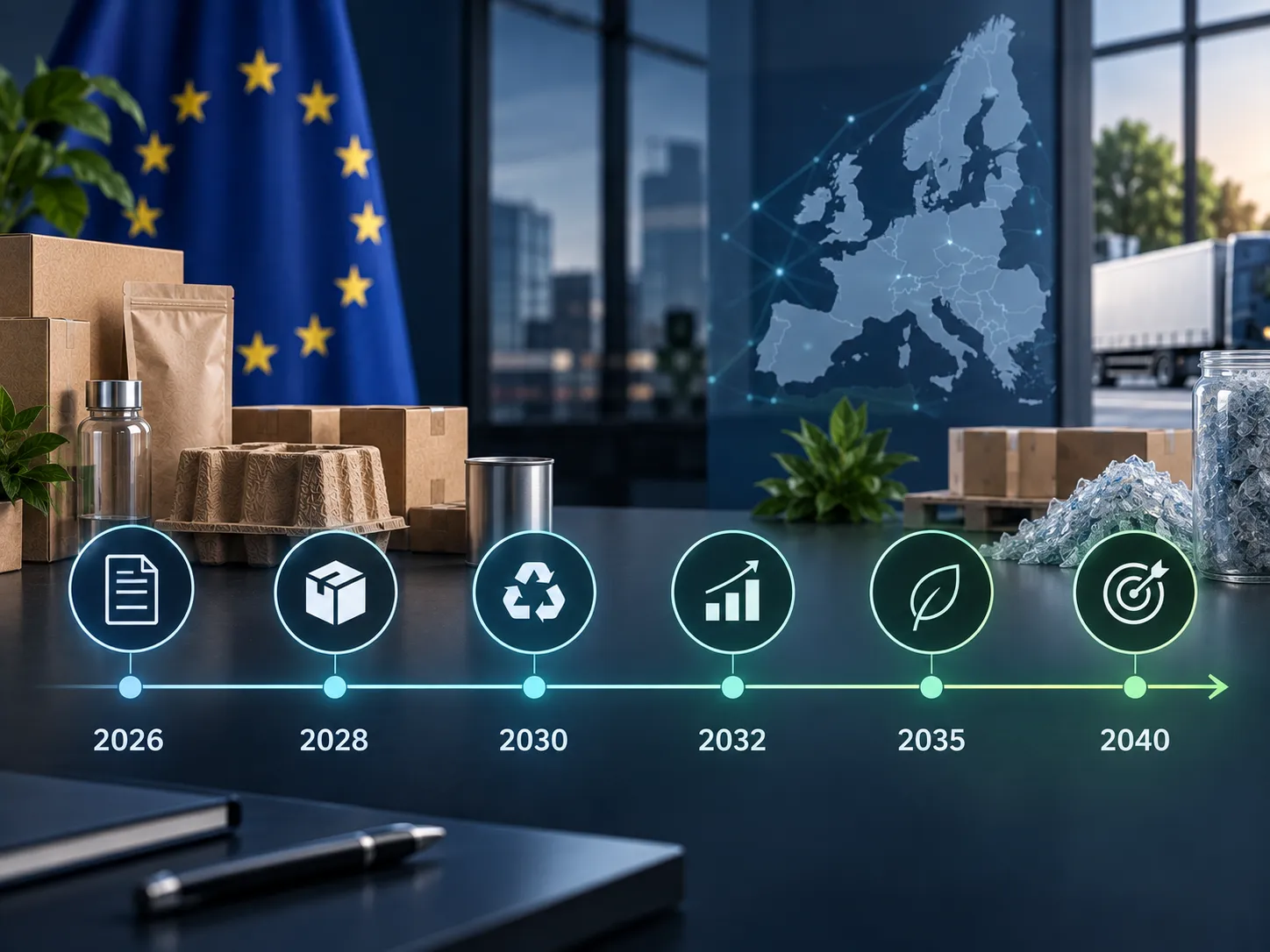
PPWR calendar 2026–2040 – key dates
The PPWR timeline does not end on 12 August 2026. Regulation (EU) 2025/40 provides for a multi-stage timetable under which further significant requirements take effect in 2028, 2029, 2030, 2035, 2038 and 2040. An additional complication is that not every date specified in the PPWR is absolute. For some requirements, the Regulation applies a mechanism whereby a specified calendar date or a specified number of months or years from the entry into force of a delegated or implementing act applies, depending on which date is later.
For a company, this means that it is not enough to put “PPWR – 2030” in the calendar. You need to know which requirement the deadline concerns, whether it covers specific packaging, which legal act will set out the methodology, and when to start redesigning, collecting data or updating the technical documentation.
PPWR timeline 2026–2040 – key dates at a glance
| Date | Key change | Legal basis | Nature of deadline |
|---|---|---|---|
| 11 February 2025 | Entry into force of the PPWR | final provisions | fixed |
| 12 August 2026 | General date of application of the PPWR | Article 71 | fixed |
| 12 August 2026 | Restrictions on PFAS in food-contact packaging | Article 5(5) | fixed |
| 2028 or later | Harmonised material labelling of packaging | Article 12 | conditional |
| 1 January 2029 | Key deadline for deposit return systems and separate collection of beverage packaging | Article 50 | fixed, with specified exemptions |
| 2030 or later | Design for Recycling criteria and recycling performance grades | Article 6 | conditional |
| 1 January 2030 | Minimum recycled content in selected plastic packaging | Article 7 | fixed, with exemptions |
| 1 January 2030 | Minimisation of packaging weight and volume | Article 10 | fixed |
| 2030 or later | Maximum empty space ratio of 50% | Article 24 | conditional |
| 1 January 2030 | Restrictions on selected single-use packaging formats | Article 25 and Annex V | fixed, with exemptions |
| 1 January 2030 | First stage of reuse targets | Article 29 | fixed, category-dependent |
| 2030 | Target to reduce packaging waste by 5% per capita compared with 2018 | Article 43 | target for Member States |
| 2035 or later | Assessment of recycling at scale | Article 6 | conditional |
| 2035 | Target to reduce packaging waste by 10% | Article 43 | target for Member States |
| 1 January 2038 | Minimum permitted recyclability performance grade B | Article 6 | fixed |
| 1 January 2040 | Higher recycled content levels | Article 7 | fixed, with exemptions |
| 2040 | Further reuse and waste reduction targets | Articles 29 and 43 | dependent on the specific obligation |
The table is intended as a guide. When planning a specific project, always check the full provision, scope of application, exemptions, and delegated and implementing acts relating to the requirement concerned.
One PPWR, but many different deadlines
The most common mistake is to treat 12 August 2026 as the date on which all final requirements take effect.
In reality, the PPWR operates in layers. Some provisions apply from the general date on which the Regulation becomes applicable. Others have their own deadlines. Still others require the Commission to adopt methodologies, labels, criteria or other supplementary acts in advance.
Therefore, the company timetable should include at least:
- the date arising from the PPWR,
- the article number,
- the type of packaging covered by the requirement,
- information on whether the date is conditional,
- the delegated or implementing act on which the deadline depends,
- the person responsible for implementation,
- the planned internal date preceding the legal deadline.
11 February 2025 – the PPWR entered into force
Regulation (EU) 2025/40 was published in the Official Journal of the European Union on 22 January 2025 and entered into force on 11 February 2025.
Entry into force did not yet mean that most provisions started to apply to businesses. The PPWR provided for a period between entry into force and the general date of application.
This period was intended to prepare businesses, Member States and the Commission for the new system.
12 August 2026 – the basic date of application of the PPWR
From 12 August 2026, the Regulation is, in principle, directly applicable in EU Member States.
For companies, this is primarily the point from which the PPWR ceases to be merely a future regulatory project.
From this date, this includes provisions defining the roles of economic operators, the obligations of manufacturers, suppliers, importers and distributors, as well as the conformity assessment mechanism and the EU declaration of conformity in respect of requirements that already apply.
However, documentation should not state that, from 12 August 2026, packaging must already meet all requirements laid down for 2030, 2035 or 2040.
12 August 2026 – PFAS limits in food packaging
One of the requirements directly relevant from the start of application of the PPWR is Article 5(5), concerning PFAS in packaging intended to come into contact with food.
The provision establishes limit values:
- 25 ppb for an individual PFAS in targeted analysis,
- 250 ppb for the sum of appropriately measured PFAS,
- 50 ppm for PFAS, including polymeric PFAS.
For businesses using food packaging, this means the need to verify the relevant materials, supplier data and evidence of conformity already at the first stage of the PPWR.
2026: technical documentation and the declaration of conformity become part of everyday compliance
Articles 15, 38 and 39 of the PPWR establish a system in which the manufacturer responsible for a given type of packaging carries out the appropriate conformity assessment, draws up technical documentation and – after demonstrating conformity – the EU declaration of conformity.
This does not mean that, in 2026, the documentation must already demonstrate compliance with a 2040 requirement. The documentation should reflect the requirements applicable to the packaging concerned at the specific time.
At the same time, it is worth collecting data needed for later obligations now, as changing packaging only when a requirement starts to apply may be considerably more difficult and costly.
2027–2028: the Commission’s delegated and implementing acts become key
The PPWR does not contain all the technical methods needed to implement the Regulation. In many places, it requires the Commission to adopt delegated or implementing acts.
They will specify or further clarify, among other things:
- design for recycling criteria,
- the method for assessing recycling performance,
- calculation methodologies,
- labelling elements,
- the method for calculating specified ratios,
- detailed reporting and verification rules.
From a compliance perspective, this is highly significant. Publication of a Commission act may trigger a period of 24 months, three years or five years leading to the later date of application of a given requirement.
PPWR labelling – 12 August 2028 will not always be the final date
Article 12(1) provides for harmonised labelling indicating the material composition of packaging.
The deadline is 12 August 2028 or 24 months after the entry into force of the relevant implementing acts – whichever date is later.
This is a classic example of why a timetable should not be created solely on the basis of the years visible in the main text of the PPWR.
A company planning a label redesign should therefore monitor both Article 12 itself and the date of entry into force of the implementing act specifying the harmonised label.
1 January 2029 – an important deadline for deposit return systems and the collection of beverage packaging
Article 50 of the PPWR lays down rules on deposit return systems and the separate collection of certain single-use beverage packaging.
The target is a very high level of separate collection – 90% for the formats covered by the provision.
By 1 January 2029, Member States must ensure appropriate deposit return systems for the indicated packaging, unless the conditions allowing use of the derogations provided for by the PPWR are met.
This is primarily a systemic obligation for Member States, but it directly affects beverage producers, retailers and operators participating in such systems.
2030 – the biggest turning point in the PPWR calendar
The year 2030 brings together the largest number of new product requirements.
During this period, the following become relevant in parallel:
- recyclability and design for recycling,
- minimum recycled content in certain plastic packaging,
- minimisation of weight and volume,
- the empty space ratio,
- restrictions on selected single-use formats,
- reuse targets,
- the first stage of the EU targets for reducing packaging waste.
A company should therefore not treat 2030 as the project start date. In many cases, redesigning packaging, validating a new material and changing supplier may require several years.
2030: recyclability and grades A, B, C
Article 6 introduces a system for assessing recyclability based on design for recycling criteria.
The PPWR provides for recycling performance grades:
| Grade | Recycling performance |
|---|---|
| A | at least 95% |
| B | at least 80% |
| C | at least 70% |
The date from which Article 6(2), point (a), applies is conditional: 1 January 2030 or 24 months after the entry into force of the relevant delegated acts, whichever is later.
This means that including only “01.01.2030 – recyclability” in the schedule is incomplete.
1 January 2030 – minimum recycled content in plastic packaging
Article 7 establishes minimum content of plastic recovered from post-consumer plastic waste for specified plastic packaging.
| Category | Minimum from 2030 |
|---|---|
| Contact-sensitive packaging made from PET as the major component, excluding the exemptions specified in Article 7 | 30% |
| Other contact-sensitive plastic packaging | 10% |
| Single-use plastic beverage bottles | 30% |
| Other plastic packaging subject to the requirement | 35% |
When applying the thresholds, you need to check the full scope of Article 7, the calculation method and the exemptions provided for. The statement “the packaging contains 30% recycled content” does not always correspond to the applicable obligation for a specific format.
1 January 2030 – minimisation of weight and volume
Article 10(1) requires packaging to be designed in such a way that its weight and volume are reduced to the minimum necessary to ensure its functionality.
This is not an obligation to reduce each item of packaging by a specified percentage.
The manufacturer should be able to demonstrate why further reduction of the packaging is not possible without impairing one of the justified functions – for example product protection, safety, logistics or legal requirements.
Therefore, before 2030, companies should prepare not only new designs, but also evidence for the technical documentation.
2030 or later – 50% empty space ratio limit
Article 24 establishes a maximum empty space ratio of 50% for the grouped packaging, transport packaging and e-commerce packaging covered by it.
However, the date is not simply “1 January 2030”.
The requirement is to apply from 1 January 2030 or three years after the entry into force of the relevant implementing acts, whichever is later.
This is particularly important for e-commerce, as the implementing act is also relevant to the method of calculating the ratio.
1 January 2030 – restrictions on selected packaging formats
Article 25 in conjunction with Annex V restricts, from 1 January 2030, the placing on the market of specified packaging formats for the indicated applications.
The list includes, among others, selected:
- single-use plastic packaging used to group products,
- packaging for certain fresh fruit and vegetables,
- formats used in the food service sector,
- single-use small packaging used in certain hotel services,
- other cases specified in Annex V.
The scope includes exemptions and detailed conditions. Therefore, the economic operator should assess the specific format and use, rather than the material alone.
2030 – key reuse targets start to apply
Article 29 establishes reuse targets for certain packaging categories, including in the areas of transport packaging, grouped packaging and selected beverage packaging.
There is no single universal “PPWR reuse” percentage for all packaging.
Depending on the format, the Regulation provides for different levels, different calculation methods and exemptions.
From a company’s perspective, it is therefore important first to determine whether the given type of packaging falls within a category covered by a specific Article 29 target at all.
2030 – 5% less packaging waste compared with 2018
Article 43 establishes targets for reducing the amount of packaging waste generated per capita.
The first target is at least 5% by 2030 compared with the 2018 level.
This is an important distinction: it is a Member State target, not a simple requirement for every company to reduce its own packaging by exactly 5%.
However, Member States may introduce measures necessary to achieve the target that will affect economic operators.
2035 – recyclability must also mean recycling at scale
From the second stage of the Article 6 system, proper packaging design alone will not be sufficient.
The assessment must also take into account whether a given packaging category is effectively recycled at scale.
This date is also conditional. Article 6(2), point (b), links the start of application of the criterion to:
1 January 2035 or five years after the entry into force of the relevant implementing acts – whichever date is later.
For a company, this means the need to monitor not only packaging design, but also future data on the operation of the collection, sorting and recycling system relevant to its category.
2035 – packaging waste reduction target increases to 10%
The next stage of Article 43 provides for at least a 10% reduction in packaging waste per capita compared with 2018.
Combined with the rules on minimisation, reuse and limiting single-use formats, this means a gradual shift in regulation from managing waste after it is generated towards preventing waste generation itself.
1 January 2038 – grade C is no longer sufficient
From 1 January 2038, packaging must achieve at least grade B for recyclability performance in order to be placed on the market.
This means an increase in the minimum threshold from 70% for grade C to at least 80% for grade B.
This is important information already at the packaging design stage before 2030. A product designed solely to meet the minimum requirements for grade C may require further modification a few years later.
2040 – a further increase in PPWR ambition
The year 2040 is another major reference point for recycled content, reuse and packaging waste reduction.
For certain plastic packaging, Article 7 increases the minimum levels of recycled content.
| Category | 2030 | 2040 |
|---|---|---|
| Contact-sensitive packaging, mainly PET | 30% | 50% |
| Other contact-sensitive plastic packaging | 10% | 25% |
| Single-use plastic beverage bottles | 30% | 65% |
| Other covered plastic packaging | 35% | 65% |
The thresholds must be applied taking into account the full scope of Article 7, calculation methods and relevant exemptions.
2040 – 15% less packaging waste per capita
The third stage of the target under Article 43 provides for a reduction in packaging waste per capita of at least 15% compared with 2018
| Year | Reduction target compared with 2018 |
|---|---|
| 2030 | 5% |
| 2035 | 10% |
| 2040 | 15% |
These are Member State targets. However, for businesses, they provide an important indication of the direction of future regulatory and economic instruments.
The key PPWR calendar pitfall: the date may depend on a Commission act
Some PPWR deadlines cannot be correctly stated as a single date without an additional condition.
| Requirement | Base date | Additional condition |
|---|---|---|
| Harmonised labelling | 12 August 2028 | or 24 months after the relevant implementing act – whichever is later |
| Design for Recycling | 1 January 2030 | or 24 months after the relevant delegated acts – whichever is later |
| Empty space ratio limit | 1 January 2030 | or 3 years after the relevant implementing acts – whichever is later |
| Recycling at scale | 1 January 2035 | or 5 years after the relevant implementing acts – whichever is later |
This is precisely why a company’s PPWR timetable should be a living document, rather than a one-off table prepared in 2026 and kept unchanged until 2040.
Not every PPWR date is a direct obligation for businesses
There are three different types of deadlines in the PPWR:
| Type | Example | Who is responsible? |
|---|---|---|
| Direct product requirement | recycled content | the relevant economic operator |
| Requirement dependent on a Commission act | Design for Recycling | the company once the relevant deadline applies |
| Member State target | 5/10/15% waste reduction | the State, which may use instruments affecting companies |
The distinction matters when building a compliance matrix. A State target should not automatically be entered as a compliance parameter for an individual bottle or box.
What should a company have in order already in 2026?
The biggest mistake would be to assume that, since some requirements start in 2030, nothing needs to be done until 2029.
It is already worth:
- taking an inventory of all packaging types,
- determining the company’s role for each type,
- assigning suppliers and components,
- collecting material specifications,
- establishing packaging versions and revisions,
- identifying requirements already in force,
- separating them from future requirements,
- marking packaging requiring redesign before 2030,
- establishing a mechanism for monitoring new Commission acts,
- linking technical documentation to specific packaging types.
The PPWR timetable should also be set out by company department
PPWR is not a project for one compliance department.
| Department | What should it monitor? |
|---|---|
| Procurement | Suppliers, material data, recycled content, specification changes |
| R&D / Packaging | Recyclability, minimisation, design, testing |
| Quality | Test reports, version identification, change procedures |
| Legal / Compliance | Deadlines, delegated and implementing acts, operator roles |
| Marketing | Labelling and changes to graphic designs |
| Logistics | Transport packaging, e-commerce, empty space and reuse |
| IT / master data | Packaging codes, components, versions, documents and deadlines |
How can the PPWR timetable be linked to technical documentation?
All declarations should not be updated simply because a date in the timetable has changed.
First, it must be established whether the new requirement:
- applies to a specific packaging type,
- changes the basis of the previous assessment,
- requires new data or testing,
- requires redesign of the packaging structure,
- requires changes to the technical documentation,
- affects the content of the declaration of conformity.
Therefore, a good system should link:
requirement → date of application → packaging type → evidence → assessment → documentation version → declaration.
Most common mistakes in PPWR timelines
- treating 12 August 2026 as the start date for all obligations;
- entering 2030 without specifying a particular Article;
- overlooking the ‘later of the dates’ condition;
- confusing a Member State target with a requirement for an individual package;
- treating 2035 as a simple, unconditional deadline for every recyclability element;
- failing to account for 2038 and the transition from class C to class B;
- having no separate plan for recycled content in 2030 and 2040;
- failing to monitor delegated and implementing acts;
- starting packaging redesign only on the date when the requirement applies;
- failing to link the timeline to technical documentation.
PPWR timeline – company implementation checklist
- Create a register of all PPWR requirements.
- Assign an Article number to each requirement.
- Record the base date of application.
- Mark deadlines dependent on Commission acts.
- Assign the requirement to the relevant packaging types.
- Identify the business owner of the requirement.
- Set an internal deadline earlier than the legal date.
- Record which data or testing must be obtained.
- Plan a design change if needed.
- Link the assessment result to the technical documentation.
- Monitor the publication of delegated and implementing acts.
- Review the timeline after every significant change in legislation or guidance.
When is it worth automating PPWR deadline monitoring?
With a few packaging types, a timeline can be managed manually. With hundreds of variants, however, dependency issues arise.
One new requirement may apply to all PET bottles but not to transport cartons. Another may apply only to e-commerce packaging. A further one may change requirements only after an implementing act enters into force.
The greatest value therefore comes from a system that does not merely store a date, but can identify which specific packages require action.
PPWR timeline – key conclusions for 2026–2040
PPWR does not have a single implementation date. 12 August 2026 is the base date from which the Regulation applies, but subsequent requirements take effect in stages.
For most businesses, the key turning point will be around 2030, when requirements concerning recyclability, recycled content, minimisation, selected single-use formats, reuse and empty space converge.
In 2035, recyclability is also to be linked to recycling at scale; in 2038, class B will become the minimum class; and 2040 will bring further increases in some targets.
The most important point, however, is to distinguish fixed dates from deadlines dependent on subsequent Commission acts. This enables a company to plan projects sufficiently early, without declaring compliance with requirements under a methodology that has not yet been finally established.
FAQ – PPWR deadlines and timeline
When does PPWR apply?
Regulation (EU) 2025/40 entered into force on 11 February 2025 and generally applies from 12 August 2026. Individual requirements may, however, have their own later deadlines.
What became applicable on 12 August 2026?</h3>
From that date, the PPWR is generally applicable, including the relevant obligations of economic operators and requirements already provided for at this stage, such as the restriction on PFAS in packaging intended to come into contact with food. This does not mean that all requirements envisaged for 2030–2040 have started to apply. </p> </div>
What changes in the PPWR from 2030?</h3>
Around 2030, the design for recycling criteria, minimum recycled content levels in certain plastic packaging, minimisation of weight and volume, restrictions on certain single-use formats, reuse targets and the empty space ratio will become relevant, among other things. Some dates depend on Commission acts. </p> </div>
Do all PPWR requirements dated 2030 start exactly on 1 January 2030?</h3>
No. For example, the design for recycling criteria and the empty space ratio use a mechanism whereby the later date depends on the entry into force of the relevant delegated or implementing acts. </p> </div>
What will change in 2038?</h3>
From 1 January 2038, packaging covered by the recycling performance grading system must achieve at least grade B, corresponding to a level of at least 80%. Grade C will no longer generally be sufficient for placing packaging on the market.
</p>
</div>
</section>
Legal basis:</strong>
Regulation (EU) 2025/40 of the European Parliament and of the Council on packaging and packaging waste – EUR-Lex
</a>
</p>
Sources</h2>
Not sure whether this applies to your packaging?
Seven questions about your situation. The result may be “you do not need this”.
Check in 2 minutes →